miércoles, 29 de septiembre de 2010

A look at 10 important philosophers

Here we got an interesting entry where we are going to show some fast facts about 10 important philosophers throught history.

1. Plato - Plato was a rationalist philosopher and one of the first philosophers in history. He came up with the idea that forms as we know them can be in various different forms in the world of forms than how they appear in the world of matter, stating how forms have a unique soul that incarnated from the world of forms to the world of matter. With his we can have essences or ideas of the physical world.

2. Aristotle - had somewhat the same idea as Plato, but he was more of an empirist philosopher than a rationalist one. He instead said how matter had a unique part called the form, and threw away the idea of the existance of the world of forms proposed by Plato. He also said how everything that we knew, or understood all come from our senses, in which later our reason enters to deal with the rest.
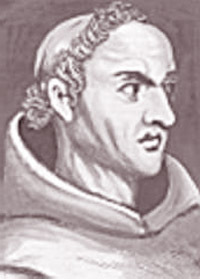
3. William of Ockham - was a Criticism philosopher saying that reason is limited and faith isn’t therefore its more reliable like to show the existence of the soul, it can’t be proved by using reason. He came up with the theory of Ockham’s Razor where the most simple theory is the most probable but not necessarily correct.

4. Rene Descartes - he said the things that exist think in his famous quote “I think therefore I exist”. Everything exists in a common space therefore matter in this space leads to physics. He also said that existence worked like a machine therefore being able to be studied. Only thing he couldn’t understand was the idea of how the mind, something that doesn’t exist physically can affect the body.

5. Spinoza -  also a rational philosopher that was his main stream. Spinoza said that the soul was perfect, but it was inside an imperfect physical body.

6. Leibniz - a rational philosopher. He said that we are all the substance of god, god is everywhere, god is everything.

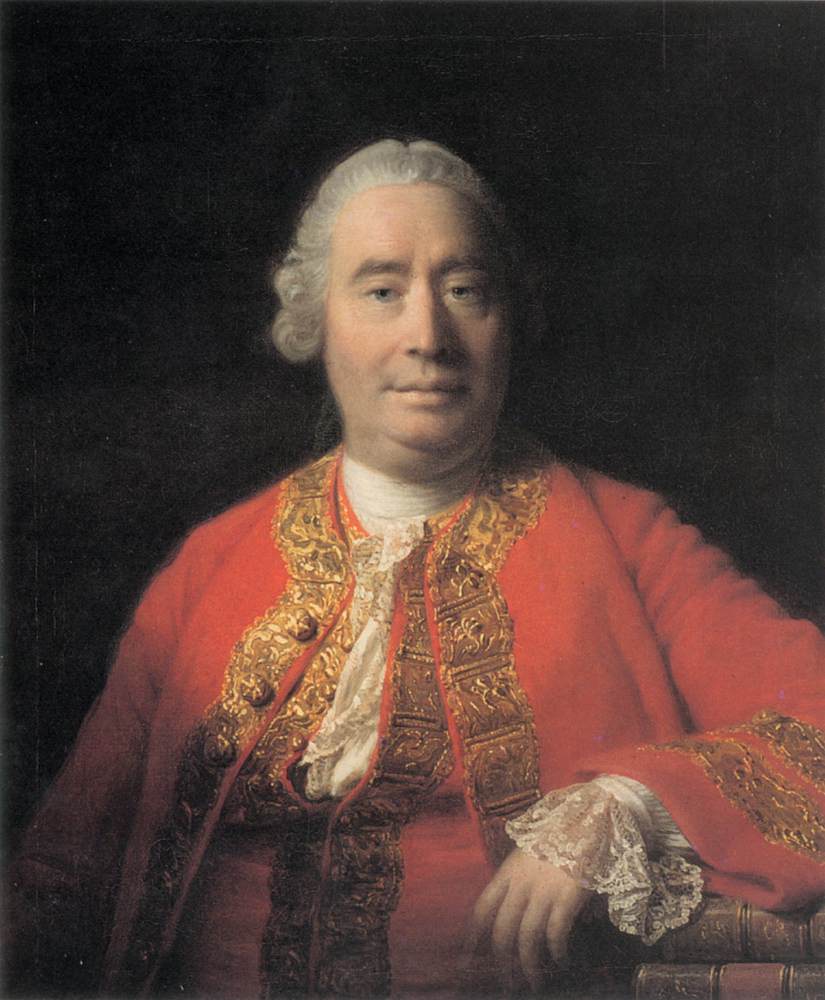
7. David Hume - he said that knowledge emerged from perceptions like ideas or impressions. He as an empirist thinker, rejected the idea of reason, where he said that things like cause and effect are product of human imagination. Therefore, our senses are the ones that give us true knowledge whether reason knowledge can be uncertain or even tell us nothing about the world.

8. Immanuel Kant - he is from the stream of criticism which means that he mixed rationalism with empiricism. He liked some things of rationalism but some not and the same goes for empiricism. Kant created the noumena and the phenomena. The noumena is the unknowable which means that there are a lot of things that we cannot know and will never be able to know and the phenomena is what our reason perceives from the world, this means that we only know the things that our reason perceives and we will not know more since it is impossible.

9. Ludwig Wittgenstein - he also comes from the stream of criticism and he is an analitical philosopher. His philosophy is taken alot in account this days becuase it is a resent philosopher. His theory said that we can acquire knowledge through the use of language, but if we want to acquire knowledge from language we have to make a right use of it.
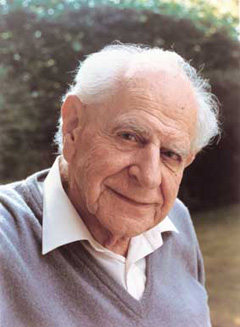
10. Karl Popper - he said that for a theory to be considered true it has to be falseable, for example in the early times of mankind people said that the world was flat, this theory is considered to be true because of what Galileo Galilei came up with his theory that the world is round. So if this theory is true than it has to be falseable by another theory and so on. Karl Popper is from the stream of criticism and he is an analitical philosopher as well.

jueves, 16 de septiembre de 2010

Epistemology: Interesting Facts About It.

Epistemology

Epistemology = is the study of knowledge and justified belief. Epistemology analyzes the criteria by which knowledge is justified. Is a doctrine that Studies scientific methods and fundaments.

Its purpose is to set the standards for the validation of all knowledge.

5 main streams
Empiricism, rationalism, skepticism, relativism, solipsism and constructivism
Sub topics

The fundamental relationship between consciousness and reality;
The nature and validity of sense-perception;
The nature of concepts and the relation between abstractions and concrete particulars;
The nature and validation of axioms, especially the laws of identity and causality;
The nature of certainty and truth as characteristics of conceptual knowledge.

10 epistemology questions

1.      How can we acquire knowledge?

Through experiences and everything perceived by our senses.

2.      Why do we have a limit at acquiring knowledge?

We can know more and more but the more we know, more questions arise, which some simply can’t be answered.

3.      What type of knowledge can we get?

Anything that sticks into our brain.

4.      How can we find the difference between true and false information?

By the knowledge one has, and by the information it has when doing the after mentioned analysis.

5.      Why do we believe in some things and not in others?

What we are sure we know we believe in, anything that is away from our understanding we don’t want to believe in.

6.      How can we be sure that we know something?

Through valid justifications that make it certain that we know something.

7.      How can knowledge be certain?

Through the justifications, ideas and concepts people

8.      How can we know that other people knowledge is certain?

Through justifications, seriousness and actions that person does.

9.      Does justifying knowledge make knowledge exist?

Yes because it tells you that you know something, that you have knowledge to justify everything without being open to a counter argument.

10.  Why is there people that believe what they believe is true?

False justifications may bring a person to believe inaccurate things.


Bibliography:

Epistemology. Standford Encylopedia of Philosophy. 16/09/10.
Definición de Epistemología. Definición.de. 16/09/10.
Kelley, David. Foundations Study Guide: Epistemology. The Atlas Society. 16/09/10.
General Questions on Epistemology. Teaching Theory of Knowledge. 16/09/10. http://www.ditext.com/clay/question.html